
Hold onto your water! Cape suppliers report countrywide demand for alternative storage
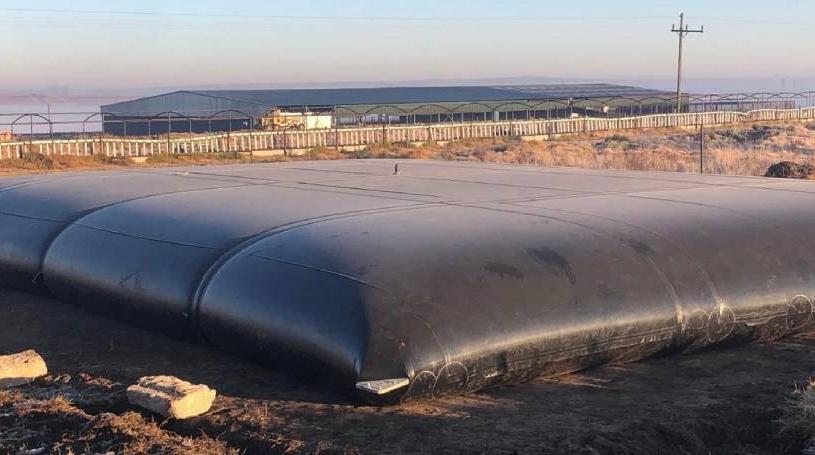
Companies supplying water storage systems report increasing demand amidst rising concern over municipal supply constraints and possible future water shortages.
Demand for products such as flexible PVC water bladders and large borehole-supplied tanks is also being driven by rising tariffs, evolving infrastructure design, and updated regulations for new residential estates.
"There is a definite increase," says Simon Cotton of Silver Solutions, who notes that customer interest closely tracks water anxiety, currently focused on the El Niño weather phenomenon. While there had been a flurry of demand several years ago when a prolonged drought forced Cape Town to contemplate potential Day Zero scenarios, current demand is generally driven by businesses needing to be more prepared for any possible supply constraints.
Cotton notes that bulk water storage technology is now much better aligned with market needs. "We know the knock-on effects of El Niño, but we are now far better equipped to supply bulk water storage systems that are highly economical compared to traditional options like concrete dams," Cotton says.
Specialising in large PVC bladders and dam liners, Cotton has supplied bulk water solutions to industrial giants such as South African Breweries and Sasol—providing the latter with roughly eight megalitres of backup storage capacity. PVC reinforced water bladders, which are also UV stabilised, range from small custom sizing to 500 000 ℓ and are easier to transport than stationary tanks. They are also locally manufactured.
In one unusual case, custom bladders were made to into a tunnel running under a client's offices. “The idea is convenience, no construction, no hassle, a long lifespan and basically just an easy setup, ensuring the bladder meets the exact 26 needs of the job," Cotton says.
Suppliers say alternative water storage is likely to increase due to the combined impacts of population growth and climate change. Despite early winter rains, Cape Town's long-term water security has come under renewed scrutiny following record-low July rainfall figures, which climate scientists have linked to El Niño conditions.
"Preliminary rainfall data indicates that Cape Town International Airport recorded its lowest July rainfall since 1958, with only 14.4 mm recorded for the month," the South African Weather Service (SAWS) confirmed in a recent statement. "This is only about 16% of the airport's long-term monthly average. The previous record low was set in 1987, when only 18.0 mm was reported."
"As El Niño is expected to strengthen further over the coming months, the likelihood of a warmer-than-normal summer over the Western Cape is expected to rise. Given the current uncertainty regarding rainfall during the 2027 winter season, the public is encouraged to use water sparingly," SAWS added.
Suppliers say storage back-up plans for commercial and industrial users is also linked to deterioration of municipal services in many areas, notably in Johannesburg.
"Both government and big business are preparing for this," says Dean Craayenstein, a bulk water storage specialist whose product lines include Videx Tanks, Cascade Clamps, and Civic Water.
"The current water storage narrative in the Cape is heavily focused on large-scale public infrastructure, such as new dams, desalination plants, and aquifer integration. While essential, these projects are slow to deliver, highly capital-intensive, and often constrained by geography and environmental approvals. Far less attention is given to modular, above-ground bulk storage solutions that can be deployed rapidly, scaled as needed, and positioned precisely where the water is required," Craayenstein explains.
"In an El Niño cycle with record-low July rainfall, the ability to capture, store, and manage water closer to the point of use is critical for operational resilience," he adds.
The shift toward decentralised storage is accelerating due to widespread municipal delivery breakdowns, particularly across Gauteng's industrial heartland and other metro areas.
"There is massive demand in Johannesburg—we hit a record month recently because of it. Businesses and residents are realising that you simply cannot function without water. Heidelberg, for instance, was left without supply for almost three weeks," Craayenstein says.
Depending on local regulations and site conditions, these alternative storage systems are increasingly being integrated into off-grid borehole setups, rainwater harvesting networks, or municipal backup feeds.
He says Civic Water is also placing increasing emphasis on water reuse and recycling, helping clients to recover and treat water: "For businesses, focus is shifting towards integrated systems that allow users to source, treat, store and reuse water closer to the point of demand, reducing reliance on municipal supply and improving long-term resilience."