
My Regional Economy: ‘Eskom unbundling should see lower energy charges for consumers’ - WCape expert
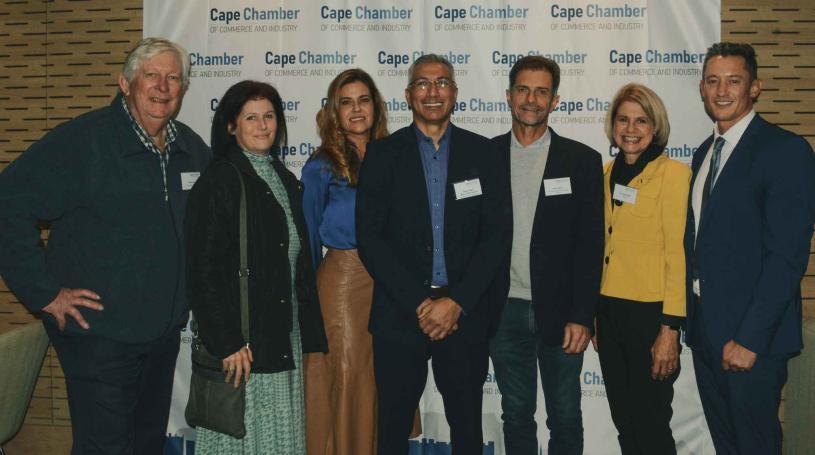
Alwie Lester (centre), Premier Alan Winde's special adviser on energy, speaks to Cape Chamber about progress and challenges
1) The power generation space is evolving. Is there now significant new capacity, and is it being produced at low-cost relative to current prices?
· There has been a shift in the generation space. About 7000mw has been added to the National system through the REIPPP. The price of the various energies vary, based on the technology whether its dispatchable or not. However what we see in the tariffs from Eskom and Municipalities is generally a blended tariff and not technology specific.
· here has also been major shifts in the Small Scale Embedded Generation (SSEG) space, with about 7000mw added national, mainly through residential and commercial solar systems.
2) What has prompted this acceleration? Is it the new regulations allowing greater generation capacity? New technology? Multiple factors?
· There are a Number of factors to consider
o The impact of loadshedding
o The Eskom unbundling
o The shift in policy and regulation
o The Eskom tariff trajectory
o Economic growth
o New technology
o Emissions factor and Paris accord
3) Are we now in a situation where we have an oversupply during the day, which presumably creates a business opportunity to store this energy and sell it at peak times to interested clients?
· The demand on Eskom has reduced, mainly due to SSEG and low growth. Technically Eskom should have more available generation. From the private sector B2B perspective, developers are selling their energy and if the energy is cheaper than Eskom over peak, they will reduce demand from Eskom over the peak period. Yes, this would create an opportunity if the energy is purchased at a good price.
4) Where do things stand currently with regard to this wheeling? Is it already up and running, or is there still a lot that needs to happen on the supply side, ie with Eskom and the City?
· Yes, wheeling is functional. Eskom has been doing traditional wheeling for some time, but has also introduced initiated virtual wheeling. In the WC, all our municipalities have been supplied with a wheeling framework and a toolkit. However not all municipalities have implemented wheeling. Each Munic will have to decide the extent of wheeling they will cater for. This is localized decision and requires the creation of certain by-laws.
5) From where you sit, what are the main obstacles to accelerating this energy market?
· The following needs to be in place:
o NTSCA must become completely independent of Eskom and be seen as an objective operator
o We need further unbundling of policy and regulations (MSA vs ERA)
o Accelerated unbuilding of Eskom
o Reform of the EDI
o Independent Market operator/operators with no vested interest
o Private sector participation in future HV/MV/LV network development (funding/ developing/operating/maintaining)
o Significant capital investment
6) And again, from what you can see, is there reason to be optimistic about capacity going forward, particularly in light of the recent IRP?
· Yes, the National IRP starts to give us broad strokes of the energy options we can consider and adds another 10000mw of renewable over the next few years. We need to find the required investment for our energy needs and be able to aggressively develop these options.
7) Where does the Province stand in relation to this? Is the Province involved in trying to expedite the regulatory or other obstacles needed to be overcome?
· Provincial government does not have a mandate for energy. The mandate for energy sits nationally, in the form of DEE and Eskom and at a local level through Municipal license holders. However we have developed an energy resilience strategy and programme for Western Cape, with the mandate taken from disaster management, We want to mitigate against any energy disaster. Of course part of our role is to advocate and drive the lessening of bureaucracy in this space.
8) Do you have a view on the recent IRP and the proposed split between nuclear and renewable energy (and other generation)?
· We participated in the public participation process for the IRP. We are not opposed to nuclear, it’s clean but not necessarily green. Our concern with nuclear has been the costs. From a renewable perspective, we would have supported more renewable being proposed.
9) I believe the previous ten-year minimum contract (for IPPs), is now down to five years. Is this a potential significant step, or is the contract period still too long in your opinion?
· Typical PPA’S where for fifteen or twenty years. A shorter period caters for changes in technology and shorter commitment periods, but has the potential to increase the price per kw/h given the shorter pay-back period.
10) Would the new energy landscape enable municipalities to shop around for power, and potentially also sell it at a higher price?
· In an ideal open market system, not only municipalities but customers would have a choice of energy type and at what time of the day they want what energy. As a principle, in the medium to long term, should municipalities look at alternative energy purchasing, the lower energy charges should be passed onto the consumer. This will speak to sustainable and affordable energy.
11) In broad terms, the easier access to wheeled energy is surely a big business opportunity. Are there any case studies or lessons to be learnt from other countries where this process has already unfolded?
· Yes, wheeling can certainly create an opportunity, but it is dependent on the generation purchase price and the wheeling charge, assuming you don’t own the network. Wheeling has been operations for many years, used by countries such as US, Germany, Philippines, India and Japan.
12) Some large customers have made commitments to be carbon neutral within 10 /20/30 years' time. Presumably this feeds into the business case for opening up the energy market?
· As SA Inc, we have made commitments to the Paris Accord. We will need to look at various options to achieve the lower emissions. The open market would be one lever, it will require new and adapted legislation, policy, regulation and monitoring and verification. From a technical perspective it would require the ability to move green electrons, whether physically or virtually, from one point to another.
13) Where do things stand regarding Eskom unbundling?
The Eskom unbundling strategy has been in the making for several years, but the most positive steps have been taken in the last few years and signaled a window in which the unbundling would be undertaken.
The formulation of the National Transmission Company of South Africa, The amendments to the Electricity Regulation Act, The formation of the Department of Energy and Electricity etc. – Decisions and announcements have all positively influenced the industry perception of Eskom and to a large extent given the private sector and the international and local investor community, comfort and confidence that South Africa was moving away from a vertically integrated monopoly.
The announcement in December 2025 that the unbundling strategy and approach would change, has caught most industry players and investors by surprise. Even Operation Vulindlela (reporting to the Presidency), responsible to unlock strategic initiatives to improve economic growth, was unaware of this change in direction.
More importantly, the Department of Energy and Electricity has just concluded an RFP process for Independent Private Transmission (IPT’s) pilots and one of the key investment factors for respondents to the RFP, was the unbundling of Eskom and the independence of NTCSA, which has now been brought into question.
The new unbundling approach in essence keeps NTCSA, Eskom Generation and Eskom Distribution in the Eskom group for a longer time, delaying the much-needed industry reform.
14) What is your view on the independence of NTCSA? Is this vital to the broader aim of bringing down the cost of power and making it more accessible?
NTCSA was well on its way to independence, but with the change in unbundling approach it has raised concerns in the industry that NTCSA will not be objective and that fair and equitable access to the Transmission network is not guaranteed.
This is further compounded with Eskom establishing its own renewable entity, which will likely compete with the private sector but have the unfair advantage of not having to go through a REIPPP process and very likely to have quicker access to a constrained Transmission network. This does not bode well for and independent and objective NTCSA (System Operator)
15) Do you have any comment on the issue of Nersa's tariff rate miscalculation, and the Department's handling thereof.
WCG opposes the process and the outcome of a negotiated settlement between NERSA and Eskom, on this matter. This decision has huge implications on citizens and residents and cannot be agreed to behind closed doors by two parties, with the expectation that a third party (consumers) who in its absence from the agreement, is now expected to pay the bill.
This R54bn error will likely create double digit tariff increases over the Multi Year Price Determination (MYPD) period. With a slow economy and low growth, increased cost of living, it is likely that our poor communities will be the most affected by these increases.
The current NERSA process does offer an avenue of recourse for interested and affected parties, which in itself is a process failure. They only have public participation in the formal MYPD process and this NERSA is considered to be a legal matter.
What is of concern is the manner in which these negotiations were conducted -- very much out of the public eye and in isolation.