
‘State Land Hoarding Underpins Cape Town Affordable Housing Crisis’ – Experts
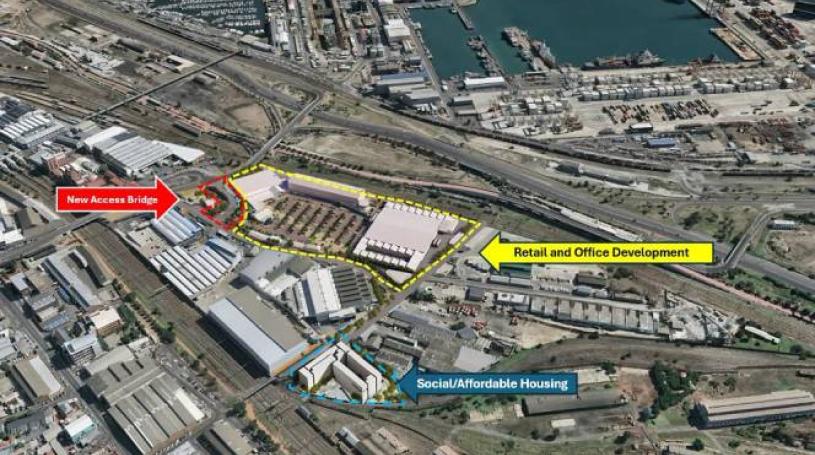
Why is the District Six redevelopment still incomplete nearly thirty years since the first land claim was lodged? And why is the national government sitting on 667 hectares of underutilised military land on Cape Town's doorstep that could eradicate a large proportion of the city's affordable housing backlog?
These questions illustrate the complexity—and mounting frustration—around Cape Town's housing debate, which is back in the spotlight following a Constitutional Court decision on the Tafelberg dispute, according to key industry and housing stakeholders in response to Cape Chamber queries.
While escalating land prices are frequently cited as the primary barrier to affordable housing delivery in Cape Town, experts point to the systemic retention of suitable land by all three spheres of government as a central bottleneck.
They say vast tranches of strategically located public land remain entirely undeveloped. Key national government properties—including Wingfield, Culemborg, Youngsfield, Ysterplaat, and large portions of District Six—have yet to be converted into affordable housing or associated public facilities.
Concurrently, the Provincial Government of the Western Cape (PGWC) retains numerous large land parcels originally reserved for schools, hospitals, and clinics that sector specialists argue are better suited for affordable residential development. At a local level, the City of Cape Town holds dozens of vacant, underutilised, or surplus municipal properties that could be adapted for mixed-use developments. These include strategic holdings such as Solole in the South Peninsula (between Capri and Masiphumelele).
The housing backlog across Cape Town and the wider Western Cape is increasingly viewed as symptomatic of a fifteen-year period of stagnant economic growth, compounded by a distinct lack of joint political will and bureaucratic coordination between national, provincial, and municipal structures.
The state points to multiple spending priorities that limit its ability to deliver housing at the required pace.
But pressure is mounting for the state to shift its approach toward land management to address spatial disparities.
"Recent public attention on land release has reinforced an important principle: well-located public land should be treated as a strategic social asset," says Anthea Houston, CEO of social housing institution Communicare. "When such land is identified and released, it provides rare opportunities to positively impact spatial justice by slightly changing the legacy of apartheid spatial planning."
Houston notes that expanding access to affordable rental homes in these zones creates inclusive neighbourhoods for households otherwise priced out of the market.
"Unlocking suitable land for these housing needs is one of the most practical steps government can take towards fulfilling its constitutional obligation and building fairer, more integrated and just cities," Houston states.
While local authorities face significant budget balancing pressures, critics point to instances where the City of Cape Town has prioritised funding for other spending priorities, while simultaneously arguing that specific well-located land parcels are too valuable for housing and must be sold to maximise municipal revenue.
Other stakeholders point to the regulatory and legal framework governing state asset disposal that has further slowed momentum. The recent Constitutional Court ruling on the Tafelberg School site in Sea Point highlighted these protracted delays, concluding a legal process that spanned a decade.
"The ConCourt ruling on Tafelberg School reflects a number of issues: it has taken the legal system a decade to rule on the matter; and the lack of judicial urgency in social matters like this clearly indicates we require public debate rather than legal navel-gazing," states Deon van Zyl, Chairperson of the Western Cape Property Development Forum (WCPDF).
Van Zyl questions the state’s internal capacity to execute complex urban infill projects on smaller, historically sensitive sites.
"Other than slapping Province on the wrist and telling it to develop a policy position, the housing opportunity is yet to be realised," Van Zyl notes. "Can government deal with small complex heritage sites like Tafelberg to provide urban housing? It appears government cannot craft complex solutions—in these cases, it should rather hand these sites to the private sector to solve with predetermined housing performance requirements."
While local and provincial authorities have proven capable of executing larger, greenfield housing developments on land currently within their portfolios, progress remains stalled on mega-sites controlled by the national government.
Although Mayor Geordin Hill-Lewis has publicly called for the national government to release major military and state assets, determining which tier of government possesses the operational capacity to manage these large-scale interventions remains unresolved.
Jeremy Wiley, a WCPDF executive committee member and Chair of the Cape Chamber's Real Estate and Construction Portfolio Committee, emphasises that neither the National Department of Human Settlements, the Department of Agriculture, Land Reform and Rural Development, nor the Department of Public Works possesses the localised capacity or resources to execute development planning and housing projects of this scale within Cape Town or the Western Cape.
"The housing backlog in Cape Town and the Western Cape is symptomatic of an economy that has not been growing strongly enough for the past 15 years and a lack of joint political will and bureaucratic co-ordination between the three tiers of government," Wiley states.
Wiley highlights that the current economic climate makes public land release an absolute necessity.
"Given the increasing popularity of Cape Town and the Western Cape as private sector investment destinations, privately owned land—including underutilised farmland—is becoming far too expensive for low-income or affordable housing. The City of Cape Town must take the lead in finding housing solutions for its poor and unhoused residents."
"I also think that the City and Prasa/Metrorail should be working much harder together to implement the “TOD” (Transit Oriented Development) Policy that focusses on developing higher density mixed-use nodes around railway stations and modal transport interchanges. The Salt River Market site, which Communicare is in the process of developing on City land after almost a decade of bureaucratic delays, is a case in point. There are several other well-located railways stations including the Cape Town Railway Station, Woodstock, Wynberg and Retreat along the Southern Line, along the Central Line including Mitchells Plain and Khayelitsha CBD, and along the Central Northern Line to Goodwood, Bellville and eastwards past Faure to Somerset West and Strand."
Most commentators agree that the operational environment for accredited social housing institutions (SHIs) has simultaneously restricted supply due to shifts in national fiscal allocations.
"Social housing is a proven part of the solution to redress and spatial justice," points out Houston. "However, the housing budget is a declining part of the national fiscus, and social housing grants have also declined in recent years. This results in reduced availability of social housing grants in metros including Cape Town. This is despite accredited social housing institutions having viable projects in their pipelines awaiting Social Housing Regulatory Authority (SHRA) funding."
While the City of Cape Town has initiated bidding processes for an isolated handful of sites, stakeholders argue that sustainable delivery requires a structured, continuous program driven by senior officials dedicated exclusively to rapid land release.
There is optimism that, for the first time in three decades, an alignment of political leadership across national, provincial, and local spheres offers a structural opportunity to establish an intergovernmental framework to release trapped public land assets. Whether the respective departments can overcome entrenched bureaucratic inertia to capitalise on this window remains the critical factor for the region's construction and residential development sectors.
Responding to Cape Chamber queries, the City reiterated the need to balance property uses within its property portfolio: "These uses are typically for community development, economic enablement, environmental protection, and housing provision.
"For properties within the human settlements pipeline, the City’s intent is to leverage the properties for housing delivered by both the private and public sector," the City says. "Cape Town’s property market presents a diverse demand for housing. As such, the City attempts to balance a range of housing needs within the property portfolio, from grant funded programmes of informal settlement upgrades and Breaking New Ground (BNG) top structure delivery to housing provided by the private sector via the GAP housing programme, Small Scale Rental Units, and Affordable Housing."
"The City administers a diverse/ extensive housing programme because it is aware that many people in Cape Town won't qualify for a bond without some support from the municipality; either through the direct provision of a structure or through working with the private sector to incentivise affordable housing delivery. The affordable housing programme target income earners who, as a household, earn less than R34 400 per month."
Whilst land parcels may be intended for future housing, a number of these sites are complicated from a development perspective. They require consolidation, investment, and bulk infrastructure enablement. As besides of the affordable housing programme, the City assumes this responsibility in order to provide unencumbered, development ready sites to the private sector," the City says.